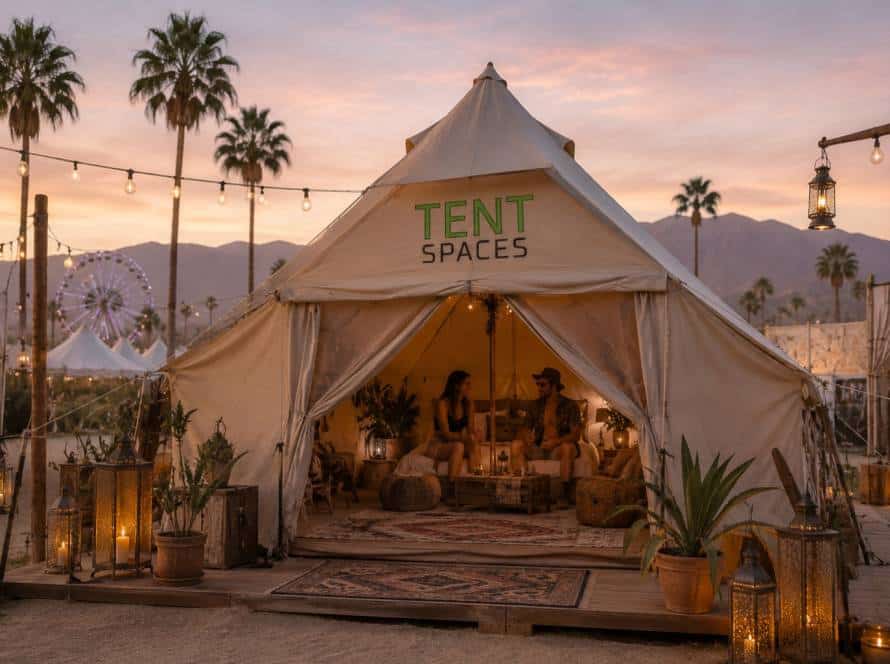
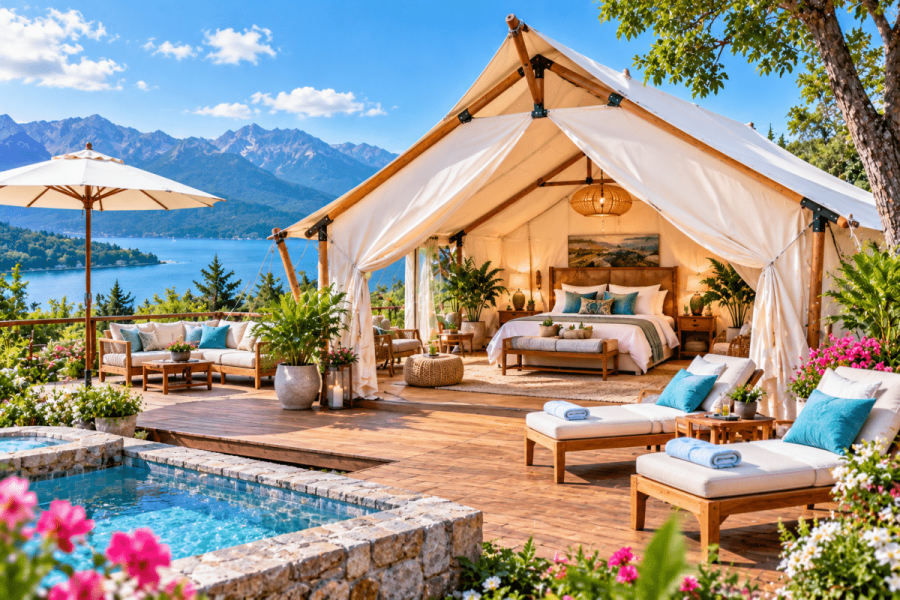
Glamping is essentially the evolution of the camping experience into a more comfortable type of accommodation with a touch of luxury that still brings you closer to nature.
Not only will these types of businesses attract the glamping market segment, but they will also be able to capture the general leisure travelers through the combination of unique accommodations and exceptional location. In the glamping scene, the focus is not really on the size of the business but whether it will meet travelers’ changing needs for quality travel experiences without the traditional hotel environment.
Glamping is an entirely different kind of lodging that doesn’t really compete with hotels and, in some cases, actually enhances guests’ travel experiences by offering different forms of accommodation like yurts, geodesic domes, cabins or tents. Explore glamping tents for your business: https://tentspaces.com/tents/
How to Start a Glamping Business
Firstly, a good idea before launching is finding out the market you intend to target.
You can begin your quest by searching for different types of stays such as hotels, vacation rentals, Airbnbs, campgrounds, and established glamping businesses around your selected area. Keep them to the ones you are traveling to and from in the same time span.
Focus on the following of these businesses:
- Average rates for a night stay
- Accommodation types offered
- Capacity of guests per unit
- Facilities provided
- Critic feedback (reviews)
- Nature of season availability
- Length of minimum required stay
- Weekday versus weekend prices
Knowing all these, you may find out what kinds of visitors are going to and from the market already, and more importantly, you will know the things that have been neglected or missing from the market. Later on, you can make choices about what you will include or not on the list in case of having multiple choices for the experiences you wish to offer. Your couples retreat type of glamping may emphasize privacy and beautiful scenery. It will also need a luxurious and high-tech interior. On the other hand, a family-friendly glamping destination will probably need bigger camping units and functional facilities. A wellness-themed glamping might offer a guest tent setup with common yoga, dining, and activity areas together. A small hotel, a campground, or an Airbnb business that currently runs only conventional accommodation can also be rearranged to use glamping tents in order to expand the number of rooms offered without building new ones. Apart from everything, in fact, your idea is only a means to your real destination, the product you will sell. And it is your chosen style of glamping which has to be the reason you go for one tent type over another. Tentspaces has a range of tents with different designs and dimensions; they are good for all kinds of glamping styles or concepts. This gives you the freedom to pick suitable and suitable enough tents depending on where you are, what the target guests are, and, of course, your overall hospitality concept. Click the link to see and discover the different glamping tents: https://tentspaces.com/luxury-glamping-tents-the-ultimate-2026-guide/

Creating a Glamping Business Plan
An adequate and good glamping business plan needs to address one major question: how will your anticipated revenue support your total investment and expenses?
There are basically four main points.
1. First-time capital
Add up your costs for tents, land where needed, platforms, electricity supply, bathrooms, landscaping work, furniture, permits, professionals’ fees, and initial marketing.
2. Running costs
Consider periodic costs like cleaning, staff, maintenance and utilities, insurance, hotel-related expenses, booking fees, etc., and also the cost of marketing your facility.
3. Income forecasts
Pick a reasonable night rate for your site and calculate how many tents you will need to be filled per night to make it profitable. Don’t rely on the hope for every tent to remain full all year round.
4. Development
It will be a wise move whether you are going to construct your full business or do so on a smaller scale and later expand based on how successful your operation has been in the first phase.
Phase-by-phase development is a great way to attract new entrepreneurs in glamping. If you do not want to risk investing ten or twenty accommodation units before you understand and assess the market’s response, you might prefer to start by launching a few really thought-out glamping units, understand your customers better, and apply guest feedback, real booking data, and market response to determine the next move. Tentspaces supplies products for various price tiers, providing glamps a great opportunity to blend a range of different models according to their business needs and glamping plans.
Startup cost to start a glamping venture? The question that everyone asks.

Setting up a glamping business is usually associated with many questions, but among the top few things that people are curious about, there is one question that is always on top: What is the startup cost to start a glamping business? No single price tag can be put on it, and the costs vary largely based on the land type and size, infrastructure, type of tents, and the regulations of the local area, etc. To get more accurate ideas on how much you would have to spend while you are starting up your glamping venture, you can separate different costs based on a couple of scenarios. If you happen to already have a piece of land on which you can build, starting your glamping business becomes much easier. You own the land already, so you can eliminate one of the main factors that would normally affect your initial investment quite heavily.
However, you might still have to make a reserve fund for the below-mentioned items:
- Glampings tents
- Beds or platforms
- Site work
- Running mains electricity
- Availability of water
- Toilets and disposal of used water
- Heating or Cooling appliances
- Eatables for dining and furnishing tables
- Cushioning the bed
- Plants and other decorations in the area
- Districts and Parking areas
- Obtaining licenses and development plans
- Buying covers such as fire and casualty
- Developing an online booking platform and website
Making the product visually appealing through photographs and promoting it to the customers. The cost of building a glamping tent should not be seen as the only capital needed, as it is only a small part of the total investment. At Tentspaces, we have the option of selecting different levels of investment, so a business can select the type of accommodation that matches its target customer rather than trying to fit their product into the same pattern that other projects have.
Starting a Glamping Business When You Need to Buy Land
If you do not own land yet, then the cost of land acquisition must be taken into consideration besides other costs. Less expensive land may not mean that glamping on it will cost less. Take, for example, a remote plot of land that will cost you a lot in terms of access to the road, electricity, water, drainage, or septic works that will have to be constructed in order to provide for facilities such as a camping facility. The situation where a parcel of land is priced quite high together with its infrastructure (utilities and other convenience features), such as road, drainage, and electric connections that are close to it, can lead to some savings in development or even construction costs. Before deciding to purchase property just for a glamping development, you need to find out what uses are permissible and what limitations there are on development. The problem with buying cheap land and, later on, finding out that you can’t develop hotel or commercial accommodation on it can turn an exciting acquisition into a very expensive disappointment.

How Many Tents Do You Need to Start a Glamping Business?
Two of your tents don’t have to come together to create 20 in total for you to start a glamping business. A lot of beginners decide that 3 or 4 glamping tents will be fine for their venture.
There are various justifications:
- Primarily, starting with 2-4 glamping tents would mean that the entrepreneur will be experimenting with market demands through the inventory without the need to have an overly heavy business burden right away.
- A small glamping site gives you the chance to learn as you go.
- You can figure out things like which unit is best reviewed, what your guests expect to pay in their room, what kind of amenities are most important for them, how long it takes for cleaning, and how seasonal your reservations really are.
- Thirdly, a small glamping development helps avoid building excess inventory before seeing any real demand.
- Imagine opening four tents with thoughtful design rather than fifteen basic ones. Focus on great pictures, the right furniture, outdoor areas, and the kind of guest experiences that are unforgettable.
- If those four units do business as well as expected, another round of glamping tents can be added to the development stage two of the business.
Best Tents for a Glamping Business
The kind of tents suitable for a glamping business largely depends on several factors such as the type of customers you expect, local weather conditions, availability of your capital, choice of land, and the rate you aim for at night. It is important to be able to make your tent business successful at all costs regardless of the factors above, and therefore a variety of tents that meet different criteria might be the wisest course. There is no such thing as only one tent model that can serve all kinds of businesses perfectly.
If affordability is one factor you would like to prioritize, the TTT1316 is a viable choice, particularly if you are planning a simple hospitality or outdoor accommodation business in the lower price segment.
Check out TTT1316 :https://tentspaces.com/tents/tentspaces-ttt1316/
In case you dream of an aesthetically remarkable accommodation, the TTT1412 is the choice for you. Because of the unique triangle shape and bold design, it can become the main feature of your glamping product—especially when you are heavily using visual content to market your property; a glamping photo can make you stand out.
Take a closer look at TTT1412: https://tentspaces.com/tents/tat1421/
For businesses who appreciate a natural, rustic look, the TML2350 features a wood structure and would beautifully combine with eco-resorts, nature retreats, and, in general, hospitality ventures.
Beyond a glamping stay, your guests will love exploring a nature setting.
Check out TML2350: https://tentspaces.com/tents/tentspaces-tml2350/
If your vision lies in offering a high-quality glamping experience that goes down to the last detail and you’re not afraid to invest the necessary resources in order to make such a unique and special glamping offering, the TCT16301/2039 is the best option for you, as it was thought out and designed as a luxurious glamping and resort-style vacation accommodation.
Discover TCT16301/2039: https://tentspaces.com/tents/tct16301-tct2039/

In a nutshell, you have to go back to your basic plan: What will your guests enjoy most about your service? Which price will be appropriate for such an experience? How much capital does it require to achieve the target revenue from this investment?
Glamping Site Design: Don’t Just Line Up the Tents
A well-designed glamping site can have a huge influence on the perceived value of the property. Guests selecting glamping usually want to have a rustic feeling; however, that by no means indicates they want their neighbors directly facing their windows. So, think about a proper level of confidentiality from the very beginning.
Some points:
- What is the view from each tent?
- What is the distance between each unit?
- Are there natural features that could provide privacy?
- Orientation of the structures
- Paths connecting guests to different places
- Where is the parking?
- Outdoor seating
- What is the fire policy where the fire pit is
- Bathrooms
- Lighting
- Landscaping
- Reception areas
Where can a guest eat, and what is the common area? Gone are the days when one had to just put tents in the ground for a glamping site. The layout should create different atmospheres and feelings for people visiting different areas of the site. You can have a premium couples’ unit area at one end of the site with the family accommodation at the other, where there is more space. The site can also have one big communal structure for breakfast, events, yoga, and guest activities where people can come together. For example, TC1240 Series can be used not only for accommodation-focused tents but also for hospitality and shared-space applications such as large-scale catering, open-air cinemas, and events. Find out more about the TC1240 Series:https://tentspaces.com/tents/tc1240-series-tents/.

Glamping ROI: What Could Your Tents Generate?
In glamping ROI calculation, the price of one tent should not be the sole factor considered. What we need to do is first figure out the total amount of money invested in the preparation of each unit for guests and then compare it to the potential annual revenue of that unit. Let’s take an easy, simple, hypothetical case. Imagine the one very luxurious glamping unit gets the average nightly rate of $180. At a 40% occupancy rate, you can expect:
$180 × 146 days = $26,280 your business would generate just by the guest bookings per year
If occupancy is 50%:
You’ll multiply $180 by approximately 183 nights – $32,940
If, suppose, the occupancy is at 65%:
$180 × 237 nights approximately = $42,660
These are just example scenarios – they can’t predict nor guarantee the actual results.
In order to have the right profit figure calculated, you must also factor in the expenses like cleaning, laundry, utilities, maintenance, manpower, insurance, taxes, online booking platform charges, marketing and, of course, financing. Therefore, this is the place where the notion of perceived value, which is an increase, plays an important role. Unique accommodation, attractive interiors, privacy, and well-designed site layout can significantly increase the price charged to a single guest, so such economics could be different quite a bit from being in a price war against competitors.
Glamping Revenue: What If You Put Up Three or Four Tents?
Let’s get back to the small business glamping concept we previously examined.
Suppose each of the four tents is priced at an average of $180 and occupied half the time.
4 × $180 × 183 nights = around $131,760 in annual gross booking revenue.
Three tents:
3 × $180 × 183 nights ≈ $98,820
These are still gross booking revenues only!
Your real glamping profits will mainly be a result of how much is spent and how popular your glamping option is in the area. A seasonal mountain retreat, for example, operates very differently from a year-round resort. Estimating a particular return based on such calculations is not the point here. Rather, they help you reverse engineer things. If you already have a rough estimate of your expenditures and investment level, you can figure out the required nightly pricing and occupancy rate that you have to attain to get the desired return level before putting it to the test.
Starting a Glamping Business through Airbnb
A major advantage of a glamping business on Airbnb is the ability to offer accommodation to travelers directly, without having to build up a customer base from scratch. In addition, a unique-style tent can help to attract attention on listings and become the main focus in photos of your listing. Nevertheless, platform-based revenue shouldn’t always be compared to revenue earned through direct booking. Besides their services, platforms such as Airbnb charge commissions. Therefore, you should calculate your earnings based on the remaining amount after you’ve accounted for any fees that have been deducted. Depending on how each account of a glamping business operates, Airbnb charges various types of booking fees. Hosts with a large inventory or more active setup, for example, might be charged differently. To ensure correct estimates, hosts would then need to consult their fee structures before calculating their revenue. Packaging the glamping experience, selling it through both offline and online platforms, and allowing customers to book via both can be very rewarding. Airbnb-like marketplaces will be a great tool to be used for discovery. However, a brand website can not only provide but also reinforce customers to visit again, foster direct relationships, and support customer loyalty. When calculating revenue, a business owner should always go with the money amount they will be left with after any deduction of fees or expenses. The price per night rate shouldn’t be the only factor taken into account here; one night may be worth more depending on the package or promotion offered.

Is a Glamping Business Profitable?
So, is a glamping business making money? It may, but profitability is determined more by the business model rather than by the tent alone. Among others, the following five factors play a major role:
Average nightly rate × Occupancy × Number of units × Operating season – Expenses
An enterprise may have very attractive tents, but due to poor marketing it will be hard for them to achieve profitability. On the other hand, a business which has great demand and overestimated construction and infrastructure costs may take longer to break-even. On the contrary, a less costly venture which offers a unique experience, good reviews, and efficient operations can produce significantly different financial performance. Glamping as a business is best analyzed based on revenue per unit available, operating costs, customer acquisition costs, and return on investment from the installed equipment. Discover more and start your first tent purchase at: https://tentspaces.com/glamping-tents-the-complete-2026-buying-guide-types-prices-best-options/
Finding a Reliable Glamping Tent Supplier
The supplier has an important role in the success of the project when a large number of tents have to be purchased. Buying in commercial quantities means that the cheapest-looking tent should not be the major factor when choosing the supplier. A professional buyer should evaluate the materials, technical details, possibilities of customisation, shipping conditions, compatibility with the intended purpose, and the track record of the supplier in the execution of commercial projects. Tentspaces, operating together with the Domespaces/Dyester group, can supply customers with different tent types for glamping and hospitality as well as commercial purposes. From the developer point of view, this implies that a single supplier is able to assist in the various components of the site—from guest accommodation units to larger-scale hospitality structures. Instead of stating one supplier as the market leader, a better question is: Is the supplier’s product the best fit for my design quality and scale requirements? At Tentspaces, for companies that want to buy in multiples, the company offers multiple models, configurations, and commercial tent applications.
Glamping planning permission
Research glamping planning permission in your intended location before booking accommodation. The regulations can vary not only by country, but also by state, county, city, and municipality.
According to the area and its laws, government officials might take into consideration:
- Land use zoning
- Total number of accommodation units
- The duration of usage of the tent/structure
- Installation of bases or platforms
- Maximum guest number
- Power supply
- Water availability
- Treatment of waste water or septic tank systems
- Fire fighting access
- Car accommodation
- Way to get there and parking
- Environmental limitations
- The property can be used commercially
The fact that a particular accommodation is a “tent” should not be a reason to disregard planning rules.
Describe in detail your entire project to the responsible local authority and, if necessary, get planning expertise advice before deciding.

What Glamping Permits Will You Need?
The requirements of glamping permits, just like those for planning permission, are mainly affected by the location of the property operation. There is a possibility that in getting the project approved, you may be required to go through zoning or land-use processes, obtain a license for campground operation, receive building permission, meet sanitation standards for disposal of waste, go through fire department inspections, register your business, comply with accessibility legislation, or obtain food-handling certifications if meals are on the menu. The requirements for a three-tent rustic escape may vary substantially from those of a full-featured 30-unit business resort. Yet another reason for carrying out the regulations check at the stage of business planning and development (rather than buying up all your gear first). In your pre-launch checklist, have permits approvals as one of the most important items.
Glamping Business Insurance
Besides the differences in glamping business insurance across various countries, the business entity can also influence insurance coverage requirements. Risks related to commercial property operations that may be beyond the scope of residential insurance. The insurer might suggest coverage such as public/general liability insurance, commercial property protection, equipment and insurance, business interruption protection, employer, or other insurance coverages that are specific for the hospitality industry. In case you have a property listed by Airbnb or another marketplace, you should not assume automatically that the platform coverages take the place of adequate commercial insurance. Give the insurer precise information concerning the property operation: how many guests it will cater to, what kind of activities and facilities they are going to offer you!
Glamping Business Loans
Financing can help you retain your budget for the development of your site as well as for buying the necessary furniture, paying for utilities, or your marketing activities. If a customer is eligible, Tentspaces can provide information regarding payment and third-party financing opportunities. Entrepreneurs who are trying to secure a business loan for a glamping venture or are considering an initial capital investment that is spread across a number of accommodation units can get information by contacting us. The eligibility for financing, interest rates, and terms will depend on the financial institutions involved and the applicant’s profile. Therefore, when choosing a financing option, be sure to check the overall cost of financing, and not only the amount that should be paid monthly. Discover Tentspaces Payment & Financing Alternatives: https://tentspaces.com/payment-options/

Start Small, Learn What Guests Want, and Expand
The only requirement is to launch a business gradually; no one would expect you to develop an entire resort right away! While many people are thinking about setting up a glamping business, there is one more feasible road for entrepreneurs:
Research – Planning – Getting approvals – Setting up 3 to 4 tents – Market testing – Improving – Extending
You will gain very detailed experience after launching those initial units. No computer spreadsheet will reveal these things to you. What is it that your customers really like? Is this type of accommodation suitable for them? What do your clients say about the place in their evaluations of the accommodation? When are you turning around guests (i.e., time interval between the departure of a guest and arrival of a guest)? What kind of amenities make your guests feel they are getting a better value for their money? To what extent should you raise the price? These are the kinds of things you learn about the business after the hotel is fully operational and open for business, you might say. Once you have these details, expansion is simply a matter of looking into your sales forecast data, not a gamble anymore. In this sense, you can think of yourself as the one running or planning a resort who is deciding on the best accommodation type to suit the needs of different target groups. Whether it’s a small hotel wanting to add some glamping cabins as an extra product offering, an Airbnb-style resort, an environmentally friendly hotel development, or starting from scratch with setting up a glamping venture that you run yourself. The choice of the most appropriate style of glamping accommodation will greatly influence how your business will be perceived, and it is one of the very top priorities to figure it out right from the get-go.
Article writer : Poonam Soni