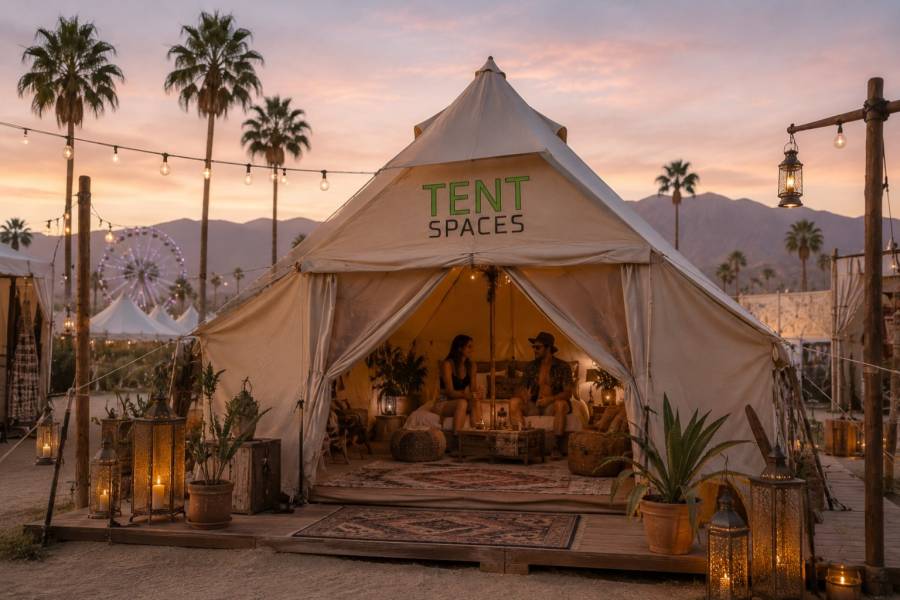
Camping has been a popular outdoor experience since the beginning of time. But more recently, glamping, a term that combines “glamorous” and “camping”, has taken over. It allows people to enjoy all the beauty of the outdoors in a luxury setting, minimizing the dirt, grime, and insect bites.
While glamping can take place in various settings and guide a wide range of experiences, there is one common denominator: luxury glamping tents. But what exactly are these tents, and what sets them apart from a regular camping tent? This article will cover all that while explaining how to find the ideal tent for your needs.
Are you ready for a glamping experience? Contact Tentspaces to find out more about our products
What is a Glamping Tent?

Luxury glamping tents have a singular feature that sets them apart from traditional camping tents; they are made for living in, not just sleeping. Whereas most camping tents have room for one or multiple sleeping bags, glamping tents typically include additional features and spaces, ranging from a small sitting area to full kitchens, bedrooms, and bathrooms.
However, like camping tents, they support the nomadic lifestyle. Though not exactly easy to assemble or disassemble, many are semi-permanent features that can be moved from one destination to another, promoting outdoor adventure. Glamping tents have been around in one form or another since the 1500s, when royalty wanted luxury camping experiences on their travels and hunts. It has grown in popularity in recent times. According to Fortune Business Insights, it is expected to grow from 3.71 billion in 2025 to 7.36 billion in 2032.
Key Characteristics
While glamping tents can vary in features, they typically offer the following characteristics:
- Size: While there are small & large glamping tents, they are typically larger than ordinary tents, with spaces for cooking, sleeping, self-care, socializing, and quiet activities. They typically offer 150 to 200 square feet but can be as large as 600 square feet or more.
- Headroom: The tents tend to offer more headroom, allowing most to stand up fully rather than crouch.
- Structural Integrity: The poles are typically flexible, absorbing wind and springing back into shape. They are often constructed from robust steel, aluminum, or hardwood and covered by a heavy-duty canvas or PVC fabric, so they hold significant weight and withstand the test of time.
- Weather Resistance: Waterproof & all-season tents are made with high-end materials and fabrics designed to withstand wind, rain, sun, and extreme temperatures, making them suitable for a range of climates.
- Infrastructure Compatibility: Many glamping tents are designed to accommodate the comforts of home, with flooring systems, electrical runs, HVAC connections, plumbing, Wi-Fi infrastructure, and external decking.
- Aesthetic: While there are no rules governing the aesthetic of a glamping tent, many decorate them to create an open, airy, inviting look.
What Glamping Tents Are Not
Glamping tents have a distinct place in the camping industry, but several products blur the line. Here’s what they are not:
- A large camping tent with upgraded bedding
- A canvas bell tent with a rug and fairy lights
- A pop-up structure used for backyard parties
While these structures can be compared to glamping tents and may even serve as an entry point for glamp-curious people, they are not the same, and it’s important to understand the distinction.
The world of glamping tents can be difficult to navigate, but TentSpaces can guide you through. Speak with one of our tent professionals today to find a product perfectly suited to your needs.
Types of Luxury Glamping Tents
Beyond features, there are various types of glamping tents available. While some are clearly glamping tents, others are adjacent options. Here are some to consider:
Bell Tents

Bell tents are so-called because they feature a single center pole pulling the canvas into a dramatic cone, or bell, shape. This signature feature is exactly what makes it not a glamping tent.
The center pole sits in the middle of the floor, interrupting furniture placement and limiting space. And while you may be able to stand up fully when you are near the pole, the sloping walls mean crouching and kneeling are more likely in most areas. Additionally, most bell tents offer only 16 square feet of space, leaving few options for additional living areas.
That said, bell tents are an affordable glamping tent alternative, making them a great entry point for those who want to experiment with glamping and glamp rentals. However, they are better for personal use. Explore our complete guide to luxury safari tents for unforgettable outdoor stays.
Safari Tent vs. Glamping Tents


Whereas bell tents are glamping tents adjacent, safari tents truly belong in the glamp tent space. They typically feature a wood-and-canvas structure, four vertical walls, and a steepled roof that provides consistent headroom, allowing the creation of real living spaces with real furniture.
Safari tents are so-named due to their African origins. British colonial settlers and aristocrats would set up these tents to enjoy luxurious amenities in the wilderness on trophy-hunting excursions. Trophy hunting declined in the mid-20th century, but the structures lived on, supporting an upscale camping experience.
Several changes occurred as safari tents evolved into more modern glamping structures. Steel and aluminum frames have replaced wood, and high-performance fabric options are now integrated. Popular contemporary amenities include dedicated bedrooms, bathrooms, lounges, kitchens, air conditioning, full-glass walls, and all-weather construction.
As sturdy units, safari tents tend to be expensive, ranging from $3,000 to $25,000. However, they last a long time and are viable commercial options for those looking to make money off their investment.
Geodesic Dome Tents

Geodesic domes are one of the most recognizable structures in modern glamping. The geodesic polyhedral shape, with triangular elements, distributes structural stress throughout the frame, allowing it to withstand heavy loads relative to its size. As a result, it stands up well to snow, wind, and other elements.
There are plenty of famous geodesic domes, including the Buckminster Fuller, the Eden Project, and the Epcot Spaceship, but the same structure can also be implemented for glamping. But are they actually tents? Not exactly.
To be considered a tent, the fabric would need to support the frame. A dome can stand on its own without the fabric’s structural support. Yet, domes are still widely marketed as glamping tents and have been accepted by consumers as such.
Domes can be quite large, with mega-domes offering up to 1,900 square feet of ground-floor space. They also typically cost $8,000 to $30,000+. However, they are suited for commercial needs and offer optimal durability. Also, explore our complete guide to Polaris TYL dome tents for unforgettable outdoor stays at: https://tentspaces.com/tents/polaris-tyl-dome-tents/
Yurts

Yurts evolved many years before glamping was a thing. They were the primary dwelling units for the nomadic people of Central Asia since 600 BD.
Signature features include a lattice wall (khana), which can be compressed for transport, a crown wheel at the apex of the roof, used for support and ventilation, and the roof poles (uni) that create the sloped-roof profile. A hardwood platform, insulated walls, and a double-skinned roof establish a yurt as a year-round dwelling.
Like safari tents, yurts have evolved significantly over the years, updating from felt-covered structures to wooden or metal frames covered with canvas and tarpaulin, featuring radiant insulation, and held together with wire rope. These more luxurious yurts are suitable for glamping.
High-quality yurts can range from $15,000 to $30,000 and are a good commercial investment, not only for their stability but also for their cultural appeal.
Bubble Tents
These are fully transparent, inflatable units that allow glampers a panoramic view of nature and a ‘sleeping-under-the-stars’ experience. However, they are not an ideal investment as they require continuous inflation to maintain their shape. They are also vulnerable to punctures, generally have poor insulation, offer no privacy, and provide little flexibility for furniture and bathroom integration.
Due to limitations, bubble tents are more commonly used as specialty units within a larger glamping property.
Individual vs. Business Tents
Glamping tents can further be broken down into individual or business tents, as follows:
Individual Tents
- Used For: Backyard retreats, vacation camping homes, or for occasional camping trips
- Size: Can range from small to large
- Portability: Could be essential if used for occasional camping trips
- Less Regulatory Complexity: Personal structures are less likely to trigger zoning, permitting, and health and safety requirements
- Lower Upfront Investment: Because individual tents are smaller than corporate tents and don’t need to meet high regulatory standards or withstand a robust business environment, they are generally less expensive.
Recommended options include Tentspaces’ Inflatable Tents, which are highly portable and ideal for first-time glampers. The CDS2500 offers a more luxurious experience, with a roomy diameter and windowed sliding doors. Our TAK2300 sits somewhere in the middle, combining upscale living with an authentic camping experience.
Corporate Tents

- Used For: Corporate retreats, pop-up shops, glamping resorts
- Size: Typically large, especially when used for customer-facing experiences
- Durability: This is essential in any commercial use space, ensuring businesses maintain ROI
- Year-Round Usability: Most businesses run year-round, requiring features like ventilation and insulation
- Strong Visual Appeal: Aesthetics are necessary, whether offering a relaxing retreat or a branded experience
- Regulatory Considerations: Commercial tents typically require permits, regulatory approval, and compliance with hospitality and safety codes.
- Higher Upfront Investment: Given the need for durability, year-round use, aesthetics, size, and regulatory compliance, business tents typically require higher upfront investment, but with a strong business model, they should eventually pay for themselves.
Tentspaces offers various corporate tent options. The TC1240 offers great coverage for pop-up markets and vendor sites. Our TTU 2000 is ideal for restaurant spaces. The TBT 5020’s outdoor patio makes it the perfect setting for an eatery with outdoor seating or an airy retreat.
Contact TentSpaces to get your quote today. Our representatives will consider your budget and glamping needs to provide a customized estimate to guide your buying decision.
Glamping Tents for Sale: Who Buys Them and Why
Glamping tents appeal to a wide variety of people, with one central connection: they want to appreciate or offer an outdoor experience in a luxury setting. Here are some popular use cases.
- Personal Backyard: Some people may erect glamping tents in their backyards. They may serve as a guest house, a home office, a yoga retreat, or a place to escape.
- Destination Travel: Glamping tents aren’t exactly the type of thing you carry on your back or throw into the trunk of a car. However, many people have their tents set up in popular destinations they like to visit, ensuring they always have a place to stay.
Commercial Resorts/Vacation Stays: The glamping experience has become so popular that it’s now offered at commercial resorts and on Airbnb. Whether an independent business or a corporation, you can set up tents on your property and rent them to people eager for a luxurious nature getaway.
Different Types of Glamping Tent Materials
Tents are also made of various materials, as follows:
Canvas vs. PVC
These are the two most common materials used to cover the tent. Here are some pros and cons of each.
Canvas
- Breathability & Insulation: This woven cotton material offers optimal breathability. It keeps the air fresh inside the tent and offers optimal insulation, making it warmer in winter and cooler in the summer.
- Water Resistance: Canvas has a self-sealing property, swelling when wet to form a natural seal against the rain. However, this means that canvas is not waterproof straight out of the package; it must be erected, soaked, and dried 2 to 4 times before it can repel water.
- Maintenance: Perhaps the biggest downside of canvas: the material must be reproofed to maintain water resistance, fully dried to prevent mildew, and UV-protected to prevent fiber degradation.
- Weight: Canvas is also quite heavy, which poses issues for portability and construction.
- Durability: While the fabric requires extensive maintenance, it can be quite durable with the proper care.
- Aesthetics: The fabric defines the glamping aesthetic, making it a popular choice for luxury campers.
- Eco-Friendly: Canvas is derived from natural cotton fibers and is fully biodegradable.
PVC
- Breathability & Insulation: Likely PVC’s biggest disadvantages, the material lacks breathability. It traps condensation inside the tent, making it warmer in summer and colder in winter. This can be managed with ventilation, but it requires deliberate attention to the design.
- Water Resistance: Polyvinyl chloride is 100% waterproof, right out of the package.
- Maintenance: The fabric can be cleaned with soft brushes and a mild detergent, without damaging the waterproof shell.
- Durability: PVC resists tearing and does not absorb moisture, preventing mold and mildew. It also provides superior UV resistance.
- Aesthetics: The material offers a cleaner, more uniform, contemporary look that may appeal to some glampers, but many find it visually cold.
- Eco-Friendly: Made from non-renewable sources and presents recycling challenges at the end of life.
PVC is generally a better choice in high-rainfall, high-humidity climates. It is also a low-maintenance, reliable option.
Canvas may be better if you are prioritizing guest experience, aesthetics, long-term prestige, and are prepared to invest in maintenance.
Frame Materials
Frame materials are arguably more important than fabric when choosing luxury glamping tents, as they are less replaceable. Popular options include:
Hardwood (Typically Pine, Oak, or Eucalyptus)
- Aesthetics: If you prioritize aesthetics, wood is an optimal choice. It offers unique and warm characteristics that blend perfectly into a natural setting.
- Durability: Wood is a durable option if treated properly.
- Maintenance: The material is susceptible to moisture, leading to cracking, wood rot, and deterioration if not treated.
- Weight: Wood is quite heavy, meaning it may not be the best choice for building and portability.
- Eco-Friendly: While wood is a natural material, sourcing matters. Ensure the timber in your glamping tent is sustainably certified.
Steel (Galvanized or Powder-Coated)
- Aesthetics: While steel may not be as aesthetically pleasing as wood, it offers a clean look. Additionally, powder-coated steel is available in a range of colors, contributing to a customized appearance.
- Durability: Steel is highly durable, offering a high strength-to-cost ratio.
- Maintenance: The material is typically available in galvanized or powder-coated form, providing a protective layer that requires little maintenance.
- Weight: Like wood, steel is quite heavy, meaning it is not ideal for those who truly appreciate a nomadic lifestyle.
- Eco-Friendly: While steel manufacturing emits greenhouse gases, its durability makes it a sustainable option.
Aluminum Alloy
- Aesthetics: While not inherently an aesthetic material, aluminum alloy is often covered by fabric in glamping units, so its appearance is rarely relevant to the experience.
- Durability: The material offers a structural strength similar to steel.
- Maintenance: Aluminum is low-maintenance because it doesn’t rust. In fact, over time, it will anodize, further improving its hardness and longevity.
- Weight: Aluminum is exceptionally lightweight, making it an excellent alternative to steel.
- Eco-Friendly: While aluminum production is energy-intensive, it is one of the most recyclable materials on earth.
Plan your new outdoor today . Speak with our experts here .
Premium Features for Glamping Tents
Consider adding the following features to make your tent truly glamorous:
- Mesh Windows and Ventilation: Ventilation is a requirement in glamping tents, not a luxury. Mesh windows are typically integrated and can be closed and opened independently to control airflow. The number of windows and placement should be customized to your tent space.
- A Stove Jack: A heat-resistant port in the roof can convert your tent from a three-season structure to a four-season one. It brings heat to your tent and can also accommodate a wood-burning stove for cooking.
- Ensuite Bathroom Integration: This can include a shower, toilet, and vanity.
- Full-Height Glass or Glazed Wall Panel: Provides a high-impact visual but can reduce insulation.
- Integrated Veranda or Deck: Extends the usable living space while providing a relaxing outdoor seating area.
- Electrical Conduit Integration: This allows for lighting, charging points, and climate control.
- Transparent or Stargazing Roof Panels: Like glass or glazed wall panels, these heighten the glamping experience but also cause insulation issues.
- Smart Home Integration: Update your tent with the latest technology, including app-controlled lighting, climate control systems, keyless entry, and digital check-ins.
- Custom Color and Branding: These options are ideal for glampers who prioritize aesthetics and for commercial businesses looking to brand their glamping units.
Which tent to buy : Your buying guide.
Choosing the right tent isn’t always easy. That’s why our team created the ultimate buying guide to help you find the glamping tent that best fits your needs.
| Decision Variable | Personal Retreat | Airbnb/ Short-Term Rental | Commercial Resort |
| Recommended Structure | Bell tent or entry safari | Mid-range safari or dome | Premier safari or dome |
| Fabric | Canvas or polycotton | Polycotton or PVC | PVC or PVDF |
| Frame | Hardwood or powder-coated steel | Galvanized steel | Galvanized steel or aluminum |
| Minimum Floor Area | 161 – 215 sq. ft. | 269 – 377 sq. ft. | 377 – 592 sq. ft. |
| Year-Round Capacity | Optional | Recommended | Essential |
| Stove Jack | Optional | Recommended | Essential |
| Ensuite Bathroom | Optional | Recommended | Essential |
| Platform Type | Timber Deck | Engineered Timber | Engineered Hardwood or Composite |
| Expected Lifespan | 5-10 years | 10-15 years | 15-20 years |
| Typical Total Cost | $3,000 – $15,000 | $20,000 – $50,000 | $50,000 – $120,000 |
| Planning Permission Required | Sometimes | Usually | Always |
| Fire Certification | Recommended | Required | Required |
If you’re still finding it hard to choose your glamping tent.Follow our step by step guide to help you out .
How to Choose the Right Glamping Tent for Sale

The information you’ve learned about glamping tents may seem overwhelming. This section outlines a simple, step-by-step process to help you find the perfect tent for your needs.
Step 1: Define Your Use Case
Use cases typically fall into one of three categories, as follows:
- Personal Use: If your glamping tent is primarily for personal use, consider how it will fit into your backyard space and its aesthetics. Ensure it is equipped to handle your needs.
- Airbnb or Vacation Use: Your tent needs to be durable enough to withstand frequent guest use and should be low-maintenance to make turnover between bookings easy.
- Resort Situations: In a resort setting, every detail must meet specifications, balancing aesthetics and durability to ensure optimal ROI.
Step 2: Assess Your Climate and Site Conditions
Here are the most important factors to consider when choosing a tent based on site conditions:
- Rainfall and Humidity: PVC and polycotton materials are recommended.
- Wind Exposure: A strong frame and anchor requirements should be considered in your buying decision.
- Temperature: Variances in temperature will guide your material and insulation choices.
- UV Intensity: Strong sunlight contributes to fabric degradation, necessitating stronger fabrics.
- Snow Load: Heavy snow requires a strong frame structure.
- Rocky Ground: Impacts platform design and anchoring.
Step 3: Determine Your Size Requirements
The best way to do this is to work your way backward. First, think about the furnishings you want. Then ensure you have the space to accommodate them.
Height is also often underestimated when purchasing glamping tents. Ensure your tent allows you to stand at full height with ample headroom in all interior areas.
Step 4: Set Your Budget
While affordable glamping tents are ideal, it’s more important to get optimal value for your money, especially if you are considering commercial rentals.
Consider that the budget often goes beyond the cost of the tent itself. You may also need to pay for platform construction, electrical and plumbing, furniture, on-site preparation, landscaping, fabric, treatments, and ongoing maintenance. Get estimates on how much all these services will cost before setting a budget for the tent itself.
Step 5: Evaluate the Frame
As the skeleton of your investment, the frame plays a key role in your purchasing decision. Your main options are hardwood, steel, and aluminum alloy. Determine which works best in your climate.
Step 6: Consider Setup and Takedown Requirements
Most glamping tents require professional installation. However, since most structures are permanent or semi-permanent, this is a one-time event that should be budgeted into the initial purchase cost.
Set-up and takedown are more of a concern for seasonal operators who need to dismantle their tents for winter storage. If you run a glamping business in this capacity, the labor, time, and wear on the structure during the installation and dismantling processes must be considered. Avoid materials that will gather mold and mildew during storage, and frame joints that will wear out quickly.
Step 7: Check the Warranty, After-Sale Support, and Spare Parts Availability
Your relationship with the retailer doesn’t end when you step out of the showroom. It extends to every warranty claim, every replacement component, and every technical question you have. Before committing to a purchase, establish:
- What the warranty covers and how long they last- consider that warranty windows may vary for different components of your tent
- After-Sale Support: Will the company continue to provide technical support, repairs, and referrals to complementary vendors and providers?
- Spare Parts Availability: Does the company offer spare parts when replacements are necessary? Or do they include spare parts in your purchase? If spare parts must be ordered after damage occurs, what is the lead time?
Red Flags to Watch Out for When buying your tent
Not all glamping sellers and manufacturers are created equal. Here are some red flags that tell you that you may need to seek out another provider:
- No Documented Technical Specifications: A legitimate manufacturer or retailer should be able to provide information on the GSM weight, frame load ratings, wind resistance specifications, and waterproof ratings.
- Pricing That Seems Too Good to Be True: If the pricing seems unrealistic, the product likely won’t be worth the money you spend. It will probably underperform or fail, costing you more in the long run.
- No Showroom, Factory, or Verifiable Installation References: Any manufacturer or sales team worth buying from can show you an installed sample of their product, ideally in conditions similar to your site.
- Vague or Inconsistent Warranty Terms: The seller should be able to clearly explain warranty terms, defining what’s covered and for how long. Statements like “We stand behind our products” are not acceptable.
- No Questions About Your Site or Climate: A sales team should start by understanding your needs and finding the ideal tent. If they don’t ask about your site and climate, they are just looking to make a quick sale.
- Long Lead Times with No Production Transparency: Glamping tents often have long lead times, with delivery taking 8 to 16 weeks. However, your seller should provide a transparent approach, an accurate timeline estimate, and updates along the way. Infinite delays and poor communication just won’t do.
Tentspaces offers reliable services. Reach out for a free quote today.
Questions to Ask Before Buying
You should come armed with questions to ask before visiting showrooms with the intent to buy. Here are some to consider asking:
What fabric weight and specifications are used for the roof vs. the walls, and why?
A responsible manufacturer will design wall and roof fabrics for different specifications and explain their choice. If they can’t, they are either cutting costs or don’t fully understand their products.
What is the frame material, the corrosion material, and the documented wind and snow load rating?
Helps you determine how well the frame will stand up to the elements.
What foundation or platform system does the tent require, and can you provide engineering drawings?
The platform is one of the most important structural components of glamping tents, and getting it wrong or not planning is among the most expensive mistakes a buyer can make. Asking about this component early on surfaces hidden costs and suitability issues, while engineering drawings reveal whether the manufacturer is operating at a professional level.
What does the installation process involve, and do you offer recommended installation services?
Similar to the platform question, asking about the installation process can uncover hidden costs, while inquiring about an installation service can bring practical benefits.
What are the separate warranty terms for fabric and frame, and what does the claims process look like?
Different components of your glamping tent may have different warranty terms. It’s wise to ask about the terms for each component and find out what you need to do to claim your warranty, ensuring an easy process.
Are spare parts stocked, and what is the typical lead time for replacement components?
Spare parts are often required in repair processes. Long lead times can delay repairs, which can be especially detrimental if you run a business, such as a glamping resort or Airbnb rental. Knowing lead times in advance will prepare you for difficult situations.
Can you provide references from installations in similar climates to mine?
Talking to references is always a good idea when you are making a major purchase. Ideally, these references will have glamping tents set up in similar climates to yours, ensuring they hold up well to the weather conditions.
What maintenance schedule do you recommend, and what happens to the warranty if maintenance is not performed?
In addition to learning about maintenance needs, you can also find out how they can impact your warranty.
Is the tent building-code compliant in my jurisdiction, and can you provide documentation to support a planning permit or application?
Ideally, the manufacturer will provide you with a package of documents that includes fire-retardancy test certificates for the fabric, structural load ratings for the frame, an engineering drawing suitable for building permit submission, and evidence of successful planning and permit applications in comparable jurisdictions.
What customization options are available, and how do they affect lead time and price?
Learn about your customization options and how they can extend lead times and increase expenses.
ROI vs. Durability
Return on Investment (ROI) and durability are essential factors to consider when purchasing glamping tents, and they deserve their own conversation.
Durability is a factor any buyer should consider. Everyone wants a glamping tent that withstands the test of time.
ROI is more specific to commercial glamping tent owners, such as those who run an Airbnb or resort property.
Here’s how to determine how each factor affects your purchasing decision.
ROI
ROI can be determined through an equation, as follows:
- Annual Gross Revenue = Nightly Rate x 365 x Occupancy Rate
- Annual Net Revenue = Gross Revenue – Operating Costs
- Simple Payback Period = Total Upfront Investment ÷ Annual Net Revenue
- ROI%= (Annual Net Revenue ÷ Total Upfront Investment) x 100
It can be difficult to estimate ROI if you are new to the business or are trying out a new tent type. However, careful research can help you get a better grasp on your potential success rates.
Durability
Durability is less mathematical. Rather than using an equation, you should consider the characteristics of your glamping tent, as follows:
Fabric Quality and Grade
- Commercial-grade canvas at 380 to 440 GSM, with proper UV treatment and annual reproofing, can last 15 to 20 years.
- Entry-level canvas at 250 to 280 GSM in a high-rainfall environment can last 5-7 years.
- High-performance PVDF-grade PVC can last 15 years or more.
- Standard PVC lasts 8-12 years with proper maintenance.
Frame and Corrosion Treatment
- Aluminum Alloy: 20-30 years with minimal maintenance
- Hot-dipped galvanized steel: 15 to 25 years in most environments- may not hold up as well in humid conditions without additional protection and maintenance
- Powder-Coated Steel: 10 to 15 years in mild climates
- Hardwood: 10 to 20 years, depending on climate, species, and maintenance routine
Other Factors Impacting Durability
- Platform Quality and Drainage: The tent should sit on a quality platform with adequate drainage to prevent moisture-related degradation.
- Installation Quality: A correctly installed tent should feature a properly tensioned frame and fabric and properly loaded anchor points, ensuring stress is equally distributed.
- Maintenance: Essential to ensuring components reach their optimal lifespan.
Contact Tentpaces for Glamping Tents You Can Count On
Glamping is a terrific experience, but the supplier makes all the difference. Purchasing the right tent can save you money in the long run, increase your ROI, and reduce ownership stress. Tentspaces can guide you on your journey.
We offer a wide variety of high-quality, luxury tents for glamping and outdoor living. Our team of experts will help you find a tent suited to your needs and preferences. We offer high-quality frames, certified materials, optimal weather resistance, easy assembly, worldwide shipping, and a 2-year warranty.
FAQs
How long does a glamping tent last?
The lifespan of a glamping tent varies based on exposure to harsh conditions, maintenance, and quality. Of the three, quality is typically the biggest factor. With that being considered, a safari tent with a galvanized steel or aluminum frame and properly treated canvas or PVDF fabric can last 15 to 20 years, while an entry-level bell tent can last 5 to 8 years.
What’s the difference between a glamping tent and a camping tent?
A camping tent is designed for portability and temporary shelter and is therefore lightweight and packable. A glamping tent is made for everyday living with a more rigid structure and often additional features like a bathroom or kitchen. It is permanent or semi-permanent in nature.
Can a glamping tent be used year-round?
A glamping tent can be used year-round if it features a heating system, insulation, ventilation, and UV, wind, and water resistance. These features ensure it will hold up to the four seasons.
Do I need planning permission to install a glamping tent?
A glamping tent installed as a permanent or semi-permanent structure is treated as a change in land use and requires planning permission, a conditional use permit, or both. Specific requirements vary by location.
How much does a glamping tent cost?
The cost of a glamping tent can vary wildly. While a simple bell tent can cost between $500 and $3,000, more structurally sound units typically range from $5,000 to $25,000. However, when it comes to luxury, the sky’s the limit. Glamping tents can cost $50,000 or more.
Writer : Marissa Kunis